There is something that I think I might have said it before in the blog, but I'm just going to say it again. There is this distance between generations, I think, even in my family. Its just this sense of apart-ness that its always there.
Education I guess, is a double-edged sword then. It empowers people with the skillsets necessary to thrive in the global economy, but then, as with the case of Singapore, it does not facilitate in the transmission of cultural artifacts/heritage, and instead, seems to tear people apart from them. Can you imagine Hokkien Opera being an CCA? Yet we allow our kids to sing Italian/Spanish/Japanese/Korean tunes! WTH!
THe cultural heritage of our parents and grandparents have been neglected, even debased, The cultural artifacts linked to our festive seasons ends up being promoted - the lion dancers, the lanterns, the mooncakes... for economic profit? drawing in the tourist dollar? As signs of a 'vibrant cultural city'? Something doesn't sync yet. Singapore still has an emerging theatrical culture, yet its being undermined in ways that are hidden. 2 steps forward 1 step back. Why can't we embrace our dialects? And why is Singlish not tolerated? Perhaps the fluidity of the Singaporean identity - the flexibility in moving from cosmopolitan to heartlander in a single larh - that is the wonder of the Singaporean.
And now that I'm here, I was reflecting about the predominant role of English as the medium of instruction, and the Singlish that young people speak. I talk about this because I've identified in another post that the main problem of Singapore's young people is that they are not immersed in the environment of speaking English, especially in the neighbourhoods. That there are structural problems that are preventing these kids from competing in the global talent marketplace, and that meritocracy, being the mindless efficient selector of talent, just disregards the place where people come from. Sometimes, it is really not that people are not hardworking enough - it really is about not even having the environment and the motivation around them that urges them to work hard. No one is stupid. Its about whether the people around them think they are stupid or not.
I think I've moved too far for one night.
Tuesday, 13 January 2009
a chasm to confess

Thursday, 8 January 2009
Reading Science Fiction and the inadequacy of our knowledge
I like Amy Tan, and about the resolution of identities. But I like Sci-Fi too - that genre of fiction that truly pushes the conception of man and who he is, in the face of technological changes. I think sci-fi writers are the real people who think seriously about the human condition and what it means.
But thats just my point of view.
I was going around the various bookstores, and I suddenly picked up 'Rise and Fall of the Third Reich', and Applebaum's Gulag. I'm not exactly sure why I bought these books, but I guess it was just a reflection of my desire to understand history.
I think it was then somewhere during this afternoon, that something hit me really badly. What we know, our knowledge, what we think we know, barely represents the thinnest topmost layer of everything that exists. The knowledge that all of us as individuals know - is barely like dust - that we know so little!
All the books that were lying out there, all the words and the texts - these things mean barely anything, if they mean anything at all! As I furiously twittered the whole afternoon - all that we know is really, truly, NOTHING. All the knowledge that we possess, is truly a chasing after the wind.
Our perception of knowledge, of reality, is so insignificant! And yet, there is a greater reality out there, a reality formed by our collective choices - a reality that is our collective consequences - the sum of the complex web of interactions and decisions. And there too, lies other things, of souls and spirits, flowing all around us. There is only so much that the human mind can grasp all at once, but there is still so much more!
All the data that we have, all the knowledge that we know, all of it is still insufficient to describe the reality that we live in. Sure, the sciences can take us somewhere there, but once will and decisions come into focus, everything changes. Before quantum uncertainty, classical chaos was already known.
So even as I engage in exploring this infinite-land of reality, in the study of sciences (chemistry) - despite all the insufficiencies of knowing barely anything at all... What is left?
The sense of humility of knowing that there is a God, who truly takes care of everything - and then the realisation, the barest, slightest, realisation, of the awesomeness of God.
Sunday, 4 January 2009
Book Review: Jared Diamond


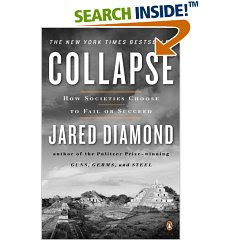
I thought that sometimes there isn't much point in talking a single book in isolation, but rather, it makes more sense to talk about books written by a single author, as I am trying to do here with Jared Diamond. He is the author of 3 wonderful books, and they are shown left to right, in the order they are published.
There is a perhaps, a sequence in the way he has written these books. The third chimpanzee was about the way humans are different and also similar with the other apes. And yes, the third chimpanzee refers to homo sapiens, and the first and second chimps are the chimps themselves and the bonobos.
It was fascinating in the way it talks about the evolutionary psychology and sexual selection, in particular, the differences in the sexual behaviour between the other great apes and human beings. To cut the long story short, there is this balls-to-body-mass ratio which seems to be the key. Gorillas have small ratios, which means that a single dominant male does not face sexual competition and practises polygamy (harems), while chimps have large ratios, which means well, the males are kinda promiscuous, but it also means that there is tremendous sexual comeptition, hence the large balls to dominate the competition. And humans have ratios somewhere in between that of chimps and gorillas, which means, that monogamy with affairs might be deemed to be a middle point between chimps and gorillas. At least thats one way of looking at it.
Then, having tackled the origins of the behaviour of people, Jared Diamond then takes on something much bigger - the progress of humanity since then. Jared Diamond examines the development of civilisation in various parts of the world, and examines why is it that Europeans and their descendants ended up dominating the world. First of all, he examines why Mesopotamia was the centre of the world's first civilisation - due to the diversity in tameable animals and abundance in grains. And then there is the whole part about the dominance of Europe - because of the competition due to the rise of different nation-states which originates from their geographical boundaries whereas in China, a centralised ruler could easily stifled innovation.
In other words, Jared Diamond has tried to bring natural history - geology and the environment, into the study of human history.
Collapse, then is about the various case studies into how different civilisations have interacted with the environment, some for better, and some for worse, and seeks to explain how and why. There is the example of the Easter Islanders, about how they unsustainably destroyed the forests of Easter Island in their construction of the stone statues, and points out to other South Pacific islands where islanders have lived in resouce-scarce areas for much linger time eras. The overall message is clear: there is really no determinism in the environment that says that people will either fail or succeed. Bad choices even in a resource-rich area will lead to collapse eventually. But good choices in a resource-poor area can still allow for a sustainable society.
Taking these 3 works combined, you could say that third chimp was about the basis of humanity, and GGS was about how the present came from the past, and Collapse is evidently about the future.
Jared Diamond is one of those synthetic thinkers that puts various different ideas together into a coherent whole. Evolutionary psychology explains perhaps, the basis of political power, and perhaps the environmental factors manifest those political power, be it the centralised form of power in ancient China or the competition between different states in Europe. And how these different forms of politics can either lead to the downfall or success of a civilisation. To tackle these immense problems, you probably need a mind as immense as Jared Diamond.
Wednesday, 31 December 2008
night cycling and lessons learnt: something about chinese, dialects, and speaking English
Here, I'm not going to add the photoes that materialised from the night cycling. I hope the photographer would upload the photoes on facebook!
Rather, what I'm going to do here is to mention the issues I've discovered from night cycling.
I've realised there is a much more serious chasm between generations, one that is worse than I expected. The kids born after the 1985s can barely understand our parent's generation born in the midst of the post-war boom. How did I know this? You know something is wrong when kids can't communicate with the chinese/dialect-speaking auntie who is taking your order at the restaurant or kopitiam. Something is seriously dead wrong.
I discovered this revelation while I was night-cycling, and we entered a dim sum restaurant that I presumed was quite traditional. When your friend has to look at the English translation of the dishes...
I think this goes beyond any talk about class warfare. It is simply this: one generation cannot understand the other, and because of this, Singapore is on the verge of losing something very precious: our past. Perhaps the govt is trying to stamp out all visages of the past in order to preserve its image of modernity - which is another figment of imagination dreamt up by a certain founding father.
There is a lack of a missing savviness, some kind of street sense, that ability to mix around with other people of different socio-economic status. From the nightcycling, I observed that Singapore is really divided not between the haves and have-nots, but rather, between the English speakers and non-English speakers. The talk about income inequality I think, is really about those who can speak English well enough to compete in the global market, and the rest of Singaporeans who have done not-so-well in English. It really just boils down to the language divide.
There is however, a silver lining in all of these. The fact that everyone has a chance to learn English and to potentially participate in the global market despite the background - that in itself is a miracle. I look at my sec 4 class again, and easily more than half have made it either to a local university or elsewhere. Yet, Geylang Methodist Secondary when we came in was just like a neighbourhood school, not unlike other secondary school, with its fair share of troubled kids in a rough neighbourhood (it was geylang, after all). Yet in that secondary school, there is a class where more than half - in fact, almost all of the kids are studying in a university, despite the middle-class background, and having parents who might not have even spoken a proper word of English ever in their whole lives (my own parents were primary school dropout). My class is a testament of how neighbourhood kids can eventually grow up to take on the world, and it is a demonstration of nothing less than the success of meritocracy in ensuring social mobility - that our birth does not decide our destiny, that it is our own choice that decide where we end up, whether we choose to persevere in our own learning...
So between the understanding of our past - of our parent's generation, and the ability to hold our futures in our own hands - how do we choose? I would like to say that these choices are not at all mutually exclusive, that a person who eats potato can also learn to appreciate the diversity of cultures out there. I write English essays, but I also can converse with childhood friends in Chinese, and army friends in Hokkien if I choose to. My culture is part of my DNA - but it doesn't determine fully who I am. I can flow between these different places, and to think of it now, these kinds of cultural legacies that are only transmitted through families - these are gifts. That my neighbourhood friends have gone so far off on the other side and chosen to live predominantly in their English-speaking universe - well I'll just be agnostic about that.
But it just seems very weird that my neighbourhood friends can't exactly hang out speaking hokkien or chinese, despite their backgrounds in middle-class families, and most of them would also be chinese speaking at home... On a lighter side, it is something quite awkward when you go to a chinese restaurant and the auntie speaks chinese and hokkien....
something to mull about...
Monday, 29 December 2008
Singapore the Nonexistent Nation
Dec 28 was the last youth service.
Anyway, the more I think about it, it didn't make any real sense to have a third youth service. It would only make sense if there was a different message, or repackaged for the youth. And the definition of youth is well, kinda irrelevant too. And its about the demographics too. There are simply less young people than before.
Anyway, I attended the service on december 28th, and I was glad I did, because Pastor Khong talked about something that struck me. He said something like, 'its a miracle that Singapore exists!' And he went on saying that Singapore has no reason to exist politically, economically, demographically, because of the limited size and population of Singapore. And he went on saying that it is God's miracle that Singapore exists and prospers.
That thought really struck me. And since I'm on this theme of the Singapore and the future, and thinking of writing something long about it, I thought that that words, Singapore, non-existent, miracle should somehow be together. So I thought something along the lines of, Singapore: Continuing the Miracle of the Non-Existent Nation.
I wonder if it might work. Still haven't even jot down a single word about all the futures that I want to write about it. But yeah. I guess all these conceptualisations are just a start. Its difficult to predict anything, especially for the future - goes that wise saying.
Hmm..
Thursday, 11 December 2008
Wednesday, 3 December 2008
i'm a... NOKIA... fan
This might be surprising, given that I have an iPod Touch and I have a MacBook...
The reason why I'm a slight fan of Nokia is because of its vision of mobile computing that it has, in reimagining how mobile devices might be like in the future. That said, I am also interested in how Apple might be having implementing its future designs. I am also, looking forward to the MacTouch or MacBook Touch sometime in the future.
I'm not really a brand fan - I'm just interested in how these companies are pushing the frontiers of consumer technology and the evolution of user interface, and of course, how technology will integrate with everyday life and reimagining the possibilities of computing.
I'm really wondering, if we already have the capabilities of supercomputers of a few decades back... oh yeah. i live in the information age... what that means...? we are still figuring out the consequences of all of these, i suppose. it took a almost a century to realise that the industrial revolution had consequences for the environment. How long will it take for us to realise the consequences of living in an information age? hmm...